

The TEF exam is the Test d'évaluation de français (TEF, French for "French assessment test"), a French proficiency test that Le français des affaires ("Business French"), part of the CCI Paris Île-de-France (Paris Île-de-France Chamber of Commerce and Industry), has issued since 1998. It comes in four versions: TEF Canada, TEF Québec (TEFAQ, the TEF adapted for Québec), TEF IRN (Intégration, Résidence et Nationalité, for residence and citizenship in France) and TEF Études (for study in France). TEF Canada is the version that Immigration, Refugees and Citizenship Canada (IRCC) accepts for permanent residence and citizenship. This guide covers all four versions of this French language test.
What is the TEF exam?
The Test d'évaluation de français is an international reference test of written and spoken French, made up of one to five tests depending on the version. TEF Canada, TEF Québec and TEF Études score each test out of 699, and TEF IRN out of 499.
The TEF Canada, TEFAQ and TEF IRN certificates show a level on the Common European Framework of Reference for Languages (CEFR), the six-level scale of language ability from A1 (beginner) to C2 (mastery). Only the TEF Canada certificate adds a Canadian Language Benchmarks (CLB) level from 1 to 12. Niveaux de compétence linguistique canadiens (NCLC) is the French name for the CLB, Canada's 12-level scale of language ability. Canadian immigration rules talk about French proficiency requirements in terms of CLB or NCLC levels. TEF results are valid for two years.
Which TEF do you need?
The TEF version you need depends on where you are going and why: Canada for permanent residence or citizenship, Québec for immigration to that province, France for residence or citizenship, or France for study. Québec's Ministère de l'Immigration, de la Francisation et de l'Intégration (MIFI, Québec's Ministry of Immigration, Francization and Integration) recognises the TEFAQ. The following table matches each version to its use.
| TEF version | Use it for | Recognised by | Tests |
|---|---|---|---|
| TEF Canada | Canadian permanent residence (Express Entry) and citizenship | IRCC; Québec also accepts it | 4 on the same day (permanent residence); Listening and Speaking (citizenship) |
| TEF Québec (TEFAQ) | Immigration to Québec; Canadian citizenship | MIFI; IRCC for citizenship only | 1 to 4, depending on the Québec programme |
| TEF IRN | Multi-year residence permit, long-term residence card and French citizenship | French Ministry of the Interior | 4 on the same day |
| TEF Études | Studying in France or at French-speaking institutions | French Ministry of Higher Education; schools and universities | 4 for first-year bachelor's admission, plus optional Speaking |
For Express Entry, the version is TEF Canada, because IRCC accepts only two French tests, TEF Canada and Test de connaissance du français (TCF, French for "test of knowledge of French") Canada.
Taking the TEF in India
You can take the TEF in India at Alliance Française centres, part of the more than 500 approved centres in over 110 countries. Each centre sets its own dates and fees.
TEF exam dates and centres in India
TEF Canada in India is conducted at the Alliance Française centres, including those in Hyderabad, Madras and Bombay. The Alliance Française Madras e-TEF (computer-based TEF) page covers TEF Canada and TEFAQ. Check the Le français des affaires centre finder for any other version. Two centres publish a session pattern.
- Alliance Française d’Hyderabad conducts e-TEF sessions on most weeks in 2026. Booking closes seven days before, and each slot takes at most four candidates.
- Alliance Française Bombay registers candidates in quarterly windows.
India has no national TEF calendar. Le français des affaires advises registering as early as possible through its centre finder.
TEF exam fees in India
The fee for the four-test e-TEF Canada in India is ₹26,000 including GST (goods and services tax) at Alliance Française Hyderabad and Alliance Française Madras. Please confirm the fee with your centre on the Alliance Française Hyderabad or Alliance Française Madras e-TEF page. Each centre sets the fee for every version, and the fee varies with the number of tests.
In Canada, the four-test TEF Canada costs CAD 390 at Alliance Française Calgary and Alliance Française Victoria. Registration is final, and fees are refunded only for a justified absence.
How to register for the TEF
To register for the TEF, apply to an approved test centre: anyone aged sixteen or over can register, and no diploma is required.
- Find a centre on the Le français des affaires centre finder.
- Confirm that a seat is free before paying.
- Submit the form with a photo and a self-attested passport copy; some centres ask for Aadhaar or PAN.
- Pay the fee; registration is final once accepted.
- Watch your email: Alliance Française Hyderabad confirms within two days and sends the hall ticket seven days before.
Le français des affaires' exam-day rules include ID and invitation checks; phones off; no dictionary; no scrap paper during Reading, Listening and Speaking; and no latecomers. The e-TEF Reading, Listening and Writing tests run on a computer, so basic computer skills are needed. French Kaliké prepares candidates for the TEF and is not a test centre. You register with a centre from the Le français des affaires centre finder.
TEF results and validity
TEF results are valid for two years, and Le français des affaires sends them by email. For TEF Canada, the certificate page says "within 1 to 10 business days", and the journey page says "approximately 2 weeks". Results arrive as a link to a digital safe that keeps the certificate for ten years; no paper certificate is issued.
The two-year validity runs "from the date of issue" on Le français des affaires' TEF Canada, TEF IRN and TEF Études pages, and "from the date of the test" on its TEF hub page. Canada and Québec apply their own age rules to results when you apply.
TEF Canada for Express Entry and Canadian citizenship
TEF Canada is the TEF version that IRCC has recognised since 2002 for permanent residence and Canadian citizenship. For permanent residence, all four tests are compulsory and are taken on the same day.
TEF exam format for Canada
The TEF Canada has four tests: compréhension écrite (Reading), compréhension orale (Listening), expression écrite (Writing) and expression orale (Speaking). Le français des affaires' test durations add up to 2 hours 55 minutes of testing.
| Test | Content | Time | How it is taken |
|---|---|---|---|
| Reading (compréhension écrite) | 40 multiple-choice questions, 4 options each | 1 h | Computer; you can move between questions |
| Listening (compréhension orale) | 40 multiple-choice questions; each recording is played once; you cannot go back | 40 min | Computer |
| Writing (expression écrite) | Section A: continue an article, at least 80 words (25 min). Section B: express and justify a point of view, at least 200 words (35 min) | 1 h | Computer |
| Speaking (expression orale) | Section A: obtain information (5 min). Section B: argue to convince (10 min). Recorded for double marking | 15 min | Face to face with an examiner |
In the multiple-choice tests, a correct answer scores 1 point, and a wrong or blank answer scores 0.
How the TEF is scored for Canada
Each TEF Canada test is scored out of 699, and the certificate shows a CEFR level and a CLB level from 1 to 12 for each test. In Reading and Listening, correct answers become a calibrated score, so the raw count is not the final score. In Writing and Speaking, two independent assessors mark each test on a standard grid.
| CCI correspondence chart, score out of 699 | Reading | Listening | Writing | Speaking |
|---|---|---|---|---|
| NCLC 7 | 434–461 | 434–461 | 428–471 | 456–493 |
Source: Le français des affaires, TEF–NCLC correspondence chart. Scores out of 699. The other NCLC levels are in the full TEF–NCLC correspondence chart.
Scores needed for Express Entry
For Express Entry under the Federal Skilled Worker Program (FSW), with French as your first official language, IRCC requires NCLC 7 in all four abilities. For the Canadian Experience Class (CEC), the minimum depends on the job's training, education, experience and responsibilities (TEER) level.
| Express Entry situation (IRCC) | Minimum on the TEF Canada |
|---|---|
| FSW, French as first official language | NCLC 7 in all four abilities |
| CEC, TEER 0 or 1 job | NCLC 7 in all four abilities |
| CEC, TEER 2 or 3 job | NCLC 5 in all four abilities |
| French as second official language (FSW points) | NCLC 5 in all four abilities, worth 4 points |
Le français des affaires lists Francophone Mobility at CLB 5 and tells candidates to check IRCC for each programme.
Which score to enter in your Express Entry profile
Enter only the "Équivalence ancien score" (old score equivalence) column of your TEF Canada certificate in your Express Entry profile, rather than the "Score / 699" column. The TEF Canada certificate carries two score columns. According to IRCC, entering the wrong column may lead to refusal of the application. Le français des affaires gives the same instruction and calls the column "Old score equivalence".
| IRCC table, "Équivalence ancien score" | Speaking | Listening | Reading | Writing | FSW points per ability |
|---|---|---|---|---|---|
| NCLC 7 | 310–348 | 249–279 | 207–232 | 310–348 | 4 |
| NCLC 8 | 349–370 | 280–297 | 233–247 | 349–370 | 5 |
| NCLC 9 and above | 371+ | 298+ | 248+ | 371+ | 6 |
Source: IRCC. "Équivalence ancien score" values, not scores out of 699.
For French as a second official language, "Équivalence ancien score" values of at least 226 in Speaking, 181 in Listening, 151 in Reading and 226 in Writing earn 4 points in total. IRCC has a separate table for TEF Canada tests taken between 11 December 2023 and 6 May 2024. Results must be less than two years old when you create the profile and again when you apply for permanent residence.
Where to find your TEF language test PIN
Your TEF language test PIN is the part after the hyphen in the attestation number at the bottom left of the TEF Canada certificate. IRCC asks for "the language test result form or certificate number and test PIN, if the system asks for it".
- The certificate number is the part before the hyphen.
- The PIN (personal identification number; NIP in French) is the part after the hyphen.
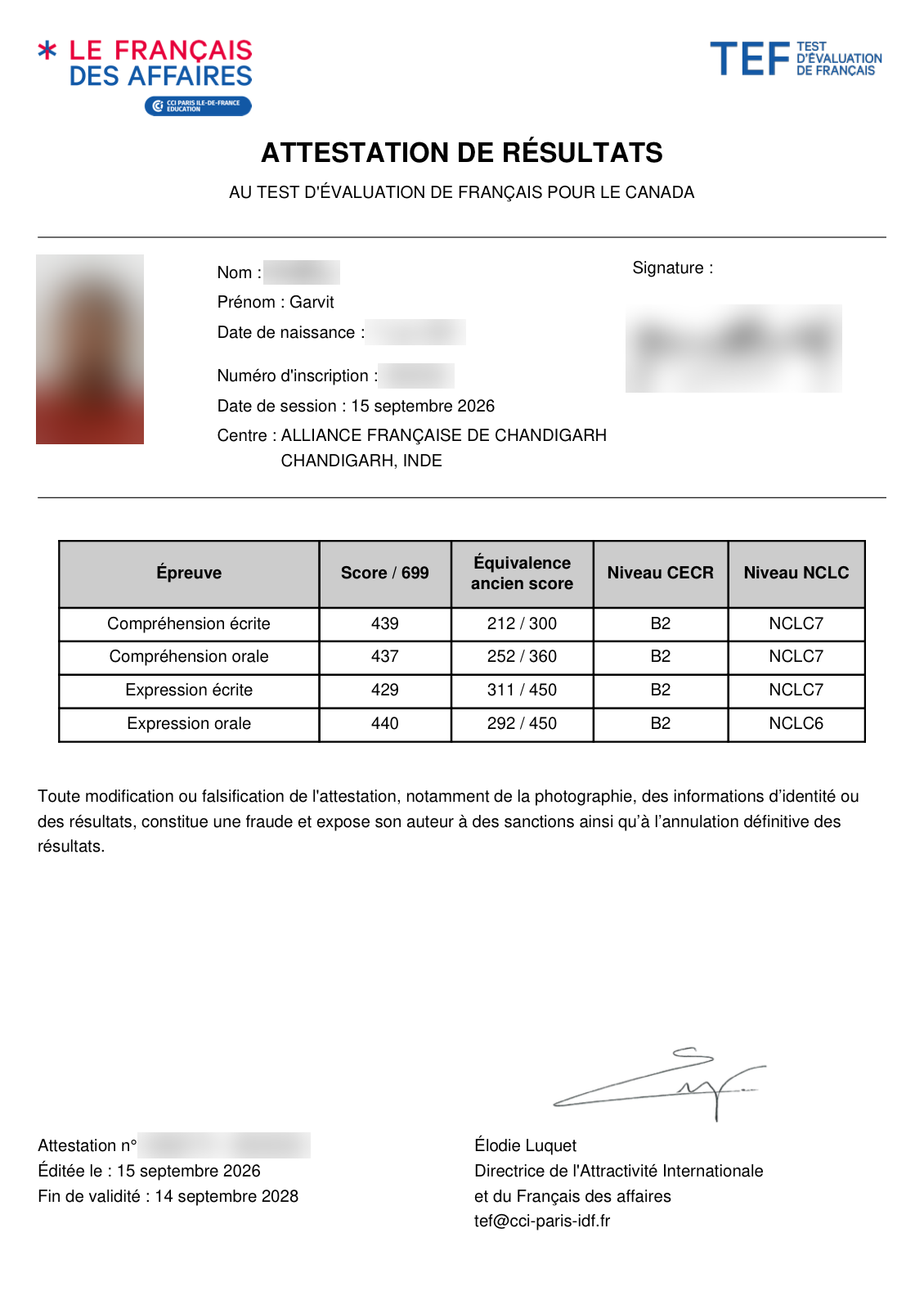
A French Kaliké student's TEF Canada certificate.
Taking the TEF for Canadian citizenship
To prove your French proficiency for Canadian citizenship, you need only the two TEF Canada citizenship tests, Listening and Speaking. IRCC asks applicants aged eighteen to fifty-four for CLB/NCLC 4 or higher in Speaking and Listening. IRCC accepts B1 or higher in Listening and Speaking on the TEF Canada (CLB 4 equivalent). TEFAQ and TEF IRN results at B1 or higher in Listening and Speaking count for citizenship too.
TEF Québec (TEFAQ) for immigration to Québec
TEF Québec, or TEFAQ (Test d'évaluation de français adapté au Québec, the French assessment test adapted for Québec), is the TEF version that MIFI has recognised since 2006 for immigration to Québec.
How the TEFAQ differs from TEF Canada
The TEFAQ and TEF Canada differ on three points: how the tests are taken, score mapping and Express Entry acceptance. The test formats are the same, and the TEFAQ certificate is valid for two years.
| Point | TEF Canada | TEFAQ |
|---|---|---|
| Tests | 4 on the same day (permanent residence); 2 for citizenship | 1 to 4, by Québec programme; each can be taken alone |
| Score scale | 0–699 per test, CEFR level, CLB level | 0–699 per test, CEFR level, mapped to the Échelle québécoise des niveaux de compétence en français (Québec's scale of French proficiency levels) |
| Accepted for Express Entry | Yes | No |
IRCC accepts the TEFAQ for citizenship at B1 or higher in Listening and Speaking. Le français des affaires expresses this as level 4 on the Échelle québécoise.
French levels Québec asks for
Québec's Programme de sélection des travailleurs qualifiés (PSTQ, Québec's skilled worker selection programme) measures French on two levels, oral and written, and Volet 1 and part of Volet 3 (a volet is a stream of the programme) require both. The PSTQ requirements set four level groups.
- Volet 1 (haute qualification et compétences spécialisées, highly qualified and specialised skills): oral level 7 or higher and written level 5 or higher; an accompanying spouse needs oral level 4 or higher.
- Volet 2 (compétences intermédiaires et manuelles, intermediate and manual skills): oral level 5 or higher; an accompanying spouse needs oral level 4 or higher.
- Volet 3 (professions réglementées, regulated professions), FEER (formation, études, expérience et responsabilités, the French form of TEER) categories 0, 1 and 2: oral level 7 or higher and written level 5 or higher.
- Volet 3, FEER categories 3, 4 and 5: oral level 5 or higher.
These levels sit on the Échelle québécoise (Québec's scale of French proficiency levels) through MIFI's correspondence tables (version of 29 November 2024). For the TEF, TEFAQ and TEF Canada, every test score converts the same way: 300–399 out of 699 is level 5–6 (B1), 400–499 is level 7–8 (B2), and 500–599 is level 9–10 (C1). Oral level 7 therefore corresponds to a score of 400 or more, and written level 5 to a score of 300 or more. Le français des affaires tells candidates to check MIFI for each programme's tests.
Does Québec accept TEF Canada?
Yes, Québec accepts TEF Canada as proof of French for the PSTQ, so one test keeps both the federal and the Québec routes open. The PSTQ French page accepts TEF Canada, TEFAQ and TEF from CCI Paris Île-de-France. It accepts five tests from France Éducation international: TCF Canada, TCF Québec, TCF, Diplôme d'études en langue française (DELF, the diploma in French language studies) and Diplôme approfondi de langue française (DALF, the advanced diploma in French language). Results must be two years old or less on the date of the permanent-selection application. Only provider-issued results from an approved centre count, sent as a full scan of the attestation.
TEF IRN for French residence and citizenship
The TEF IRN (TEF Intégration, Résidence et Nationalité) is the TEF version recognised by the French Ministry of the Interior for residence permits and French citizenship. The TEF IRN assesses everyday French from A1 to B2 for foreigners over sixteen, and each of its four uses needs a set level.
- multi-year residence permit: A2
- long-term residence card (carte de résident): B1
- French citizenship: B2
- private security work in France: B1
The exam has four compulsory tests on one day, and the test durations add up to 90 minutes. Reading has 20 questions in 30 minutes, and Listening has 20 in 20 minutes. Writing has two tasks of at least 40 and 100 words in 30 minutes, and Speaking has two face-to-face tasks in 10 minutes. Reading and Listening are adaptive: the first 10 questions assess your level, and the next 10 match it. Each test is scored out of 499, and B2 needs 400 or more on three tests and at least 367 on the weakest.
Le français des affaires states that TEF IRN results are not appropriate for higher education, and they count for two years from the date of issue. French Kaliké's Lys piste (track) for France prepares learners for the DELF, which is valid for life. The DELF exam guide covers its levels, format, fees and dates.
TEF Études for studying in France
The TEF Études is the TEF version for study admissions, recognised since 2002 by the French Ministry of Higher Education and by schools and universities. Since 2004, it has been part of the Demande d'Admission Préliminaire (DAP), the procedure for first-year bachelor's admission in France. For the DAP, it has four tests.
| Test (DAP) | Content | Time |
|---|---|---|
| Reading | 40 multiple-choice questions | 1 h |
| Listening | 40 multiple-choice questions | 40 min |
| Vocabulary and syntax | 40 multiple-choice questions | 30 min |
| Writing | 2 sections, at least 80 and 200 words | 1 h |
Speaking (15 minutes) is optional for the DAP. TEF Études is the only TEF version with a vocabulary and syntax test. First-year enrolment needs at least 400/699 in the four written tests, and results are valid for two years from the date of issue. Outside the DAP, each institution sets its tests and level, and many French-speaking institutions outside France, especially in Canada, accept the TEF Études.
Holders of a TCF for the DAP, a DELF B2, a DALF C1 or C2, or a French baccalauréat (the school-leaving diploma) are exempt from the DAP language test. Some schools still require a test. French Kaliké's DELF B2 course prepares learners for the DELF B2.
How to prepare for the TEF
My TEF/TCF batches prepare students for the TEF Canada, and the TEFAQ uses the same test formats. I coach the other TEF versions (TEF IRN, TEF Études) only on request. My method rests on continuous evaluation; weekly Listening, Reading and Writing tasks; all material provided; and a short recording of each class the following day.
How I prepare students for each test
Each TEF Canada test gets its own score and its own NCLC level, so I train the four tests separately.
| Test | What it asks | How I train it |
|---|---|---|
| Reading | 40 questions in 1 hour | Le Monde articles, chart- and statistics-based questions modelled on the TEF/TCF, and texts on artificial intelligence, climate change, health and more. |
| Listening | 40 questions; each recording is played once | More than 80 exercises across the course, every week. |
| Writing | 80 words, then 200 words; two assessors mark it | More than 50 expressions écrites (EE, the Writing task) across B1 and B2, each with individual feedback. |
| Speaking | Section A, obtain information; Section B, argue to convince; recorded | An exam simulation in every class, run exactly as the real test. |
To practise Writing, I assess how every student’s Writing evolves from A1 through B1-end. I closely monitor the mistakes they make (for instance, verb + que + subjunctive constructions at B1), and the class discusses every EE together. One of the B1 class clips on my homepage comes from this Speaking practice.
French sounds for speakers of Indian languages
French sounds matter for both your Listening and Speaking scores, so I teach them by contrasting them with your mother tongue, starting with the sounds your language lacks. For instance, here are two sounds that your language might lack:
- The French /ɥ/, a “voiced labial–palatal approximant” as in huit (‘eight’), is absent from all twenty-two scheduled Indian languages.
- The French /ʁ/, a “voiced uvular fricative” as in rouge (‘red’), is absent from all scheduled Indian languages.
In the Speaking section, two mistakes are the most common. First, students read /œ/ as /e/ after a consonant, as in ne in negative sentences, mostly at A1. Secondly, an English habit makes them read the letter a as /eɪ/ or /ə/ at the start of a word or after a consonant. French /a/ needs a much more open mouth, as in pratique (‘practice’) or avis (‘opinion’).
In the Listening section, students usually struggle with two aspects of Canadian French phonology:
- Diphthongs: the ou of tour (‘tower’) is pronounced [uw] unlike the [u] of Standard French.
- Assibilation: /t/ and /d/ become [t͡s] and [d͡z], so tigre (‘tiger’) sounds like "tsigre" and dîner (‘dinner’) like "dziner".
My Advanced Pronunciation course opens only after B1.2 at French Kaliké. Students at that level can join the Advanced Pronunciation and Speaking course.
Can you prepare for the TEF in 3 months?
Yes, you can prepare for the TEF in 3 months if you are already at B1.2 level; below that, give yourself more time. My students need at least a year from zero to B1.2, and a year and a half to B2, where they usually reach NCLC 7 or higher. Each part of my Érable piste (track) (A1 → A2 → TEF/TCF B1.1 → B1.2 → B2.1 → B2.2) lasts three months (this timeline only highlights the course duration and does not guarantee a pass). The Alliance Française d’Hyderabad suggests at least B2 (660 hours) before the e-TEF.
Book once you can do two things.
- Prepare each Speaking section in under two minutes while following all its instructions.
- Write two EEs with minimal spelling and grammar mistakes in under 1 hour 20 minutes without referring to any (online or offline) material.
The 1 hour 20 minutes is my practice benchmark in class; the exam's Writing test lasts 1 hour. Readiness matters because registration is final, a retake needs a twenty-day wait, and Alliance Française Hyderabad seats at most four candidates per slot.
Preparing for the TEF with French Kaliké
French Kaliké offers live group classes on Google Meet in small batches, with no one-to-one classes. My TEF/TCF batches start at B1, with Québécois pronunciation from B2 and in C1. My homepage shows two TEF Canada results, scores out of 699: Listening 556 (C1, NCLC 10) and Writing 498 (B2, NCLC 8). The "Watch free demo" button plays a recording of a real lesson.
- French A1 course
- French A2 course
- TEF and TCF Canada B1 course
- TEF Canada exam preparation at B2 level
- DALF C1, TEF and TCF C1 course
TEF vs TCF for Canada
Both the TEF Canada and the TCF Canada are accepted by IRCC and by Québec, so choose your test based on your preferred format, on your strengths and on the test dates for the centres near you.
| Point | TEF Canada | TCF Canada |
|---|---|---|
| Issuer | Le français des affaires, CCI Paris Île-de-France | France Éducation international |
| Speaking | 2 tasks, 15 min | 3 tasks, 12 min including 2 min of preparation |
| Accepted by IRCC and Québec | Yes | Yes |
I initially recommend that my students appear for both TEF Canada and TCF Canada; and then, as I get to know the student better from A1 through B1, depending on their strengths and weaknesses, I suggest one over the other. My TEF and TCF Canada B1 course covers both tests. The TCF exam guide covers the TCF versions, scores and fees in detail.
Is the TEF exam difficult?
The TEF Canada does not ‘pass’ or ‘fail’ candidates. The FSW needs NCLC 7 in all four abilities, and Canadian citizenship needs B1 or higher in Listening and Speaking. TEF Études needs 400/699 in the written tests for the DAP, and TEF IRN needs B2 for French citizenship. However, the three parts of the format are demanding.
- Listening recordings play once.
- Writing Section B needs 200 words or more in 35 minutes.
- Speaking Section B is a 10-minute argument.
In my experience, the TEF Canada is more tiring than the TCF Canada, and high scores are a little harder to reach.
TEF exam FAQs
What is the official TEF website?
The official TEF website is lefrancaisdesaffaires.fr, the site of Le français des affaires, CCI Paris Île-de-France. Registration goes through approved test centres, which candidates find with the site's centre finder.
How many times can you take the TEF?
Candidates can take the TEF as many times as they like, with a twenty-day wait between two sessions, according to Le français des affaires. Each centre has its own booking rules, so candidates check them before booking.
Can you get a refund if you miss the TEF?
No, candidates who miss the TEF usually cannot get a refund, because registration is final. Le français des affaires may offer a free new registration for a major reason, such as illness, work or bereavement, if the centre receives proof.
Can you appeal for a TEF Canada score?
Candidates can appeal for a TEF Canada score only within thirty days of the certificate's issue, and only for an anomaly or serious malfunction during the test. The candidate tells the supervisor about the problem on the test day.